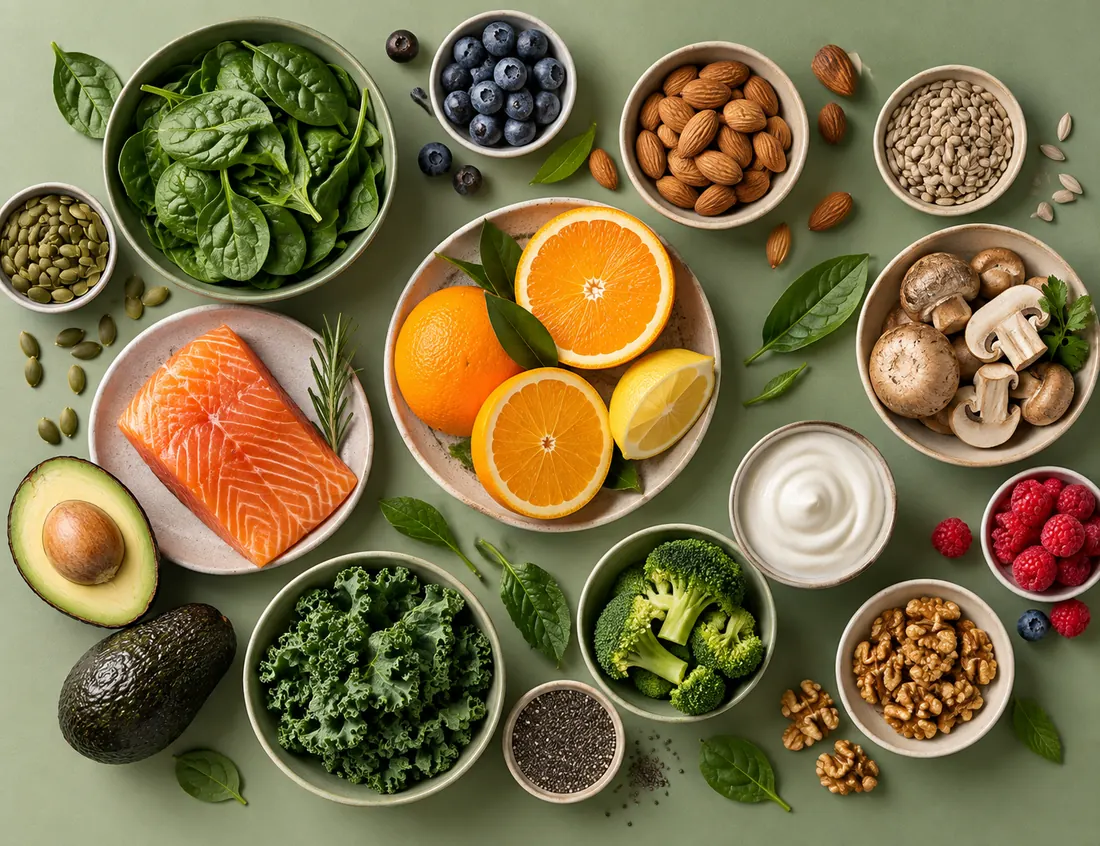
Vitamins vs minerals
Vitamins are organic compounds your body needs in small amounts but mostly can’t make itself. Minerals are elements such as magnesium, zinc and iron that come from soil and water, and reach you through plants and animals.
Both work as helpers: they switch on enzymes, build tissues and keep signals moving between cells. You need only milligrams or micrograms a day, but running low for months can leave you tired, foggy or getting sick more often.
Fat-soluble and water-soluble
Vitamins A, D, E and K are fat-soluble: they absorb best with a meal that contains some fat and are stored in the body. The B vitamins and vitamin C are water-soluble: your body uses what it needs and excretes the rest, so you need them more regularly.
| Nutrient | What it does | Where to find it |
|---|---|---|
| Vitamin D | Immune function, bones and teeth | Sunlight, oily fish, fortified foods |
| Vitamin C | Immune function, collagen formation | Citrus, peppers, berries, kiwi |
| Vitamin B12 | Energy metabolism, red blood cells | Animal foods, fortified plant milks |
| Magnesium | Muscles, nerves, energy production | Nuts, seeds, leafy greens, whole grains |
| Zinc | Immune function, skin, hair | Legumes, seeds, shellfish, meat |
| Omega-3 (EPA & DHA) | Heart, brain and eye health | Oily fish, algae |
The ones most people miss
Even with a good diet, a few nutrients are commonly low:
- Vitamin D — in most of the northern hemisphere the sun is too weak to make enough from roughly October to March, and many people spend most days indoors.
- Magnesium — processed foods are low in it, and stress and exercise increase how much you use.
- Omega-3 — if you eat oily fish less than twice a week, you are likely below recommended intakes.
- Vitamin B12 — found almost only in animal foods, so it is essential for vegans and often low in vegetarians and adults over 50.
- Iron — common in people who menstruate. Only supplement iron after a blood test, as too much can be harmful.
The simplest way to know your levels is a blood test. Ask your doctor about vitamin D, B12, ferritin (iron stores) and folate.
Why the form matters
The same nutrient comes in different chemical forms, and your body absorbs some far better than others. A few examples:
- Vitamin D3 (cholecalciferol) raises blood levels more effectively than D2.
- Magnesium bisglycinate is gentle and well absorbed; magnesium oxide is cheap but poorly absorbed and can upset your stomach.
- Methylcobalamin and methylfolate are active forms of B12 and folate that your body can use right away.
That is why we only use well-absorbed forms — you can see exactly which ones on every product page, for example Magnesium B6 or D3 + K2.
Food first, supplements to fill gaps
Supplements work best as a top-up, not a replacement. A varied diet gives you fibre, antioxidants and thousands of plant compounds no capsule can match. Think of supplements as a way to cover the specific gaps your lifestyle, diet or season creates.
Key takeaways
- Fat-soluble vitamins (A, D, E, K) absorb best with food that contains fat.
- Vitamin D, magnesium, omega-3 and B12 are the most common gaps.
- The form of a nutrient affects how much your body actually absorbs.
- A blood test is the best way to know what you need.
This guide is general information, not medical advice. If you are pregnant, breastfeeding, taking medication or managing a health condition, talk to your doctor or pharmacist before starting any supplement.